
Thymic Health consequences in adults
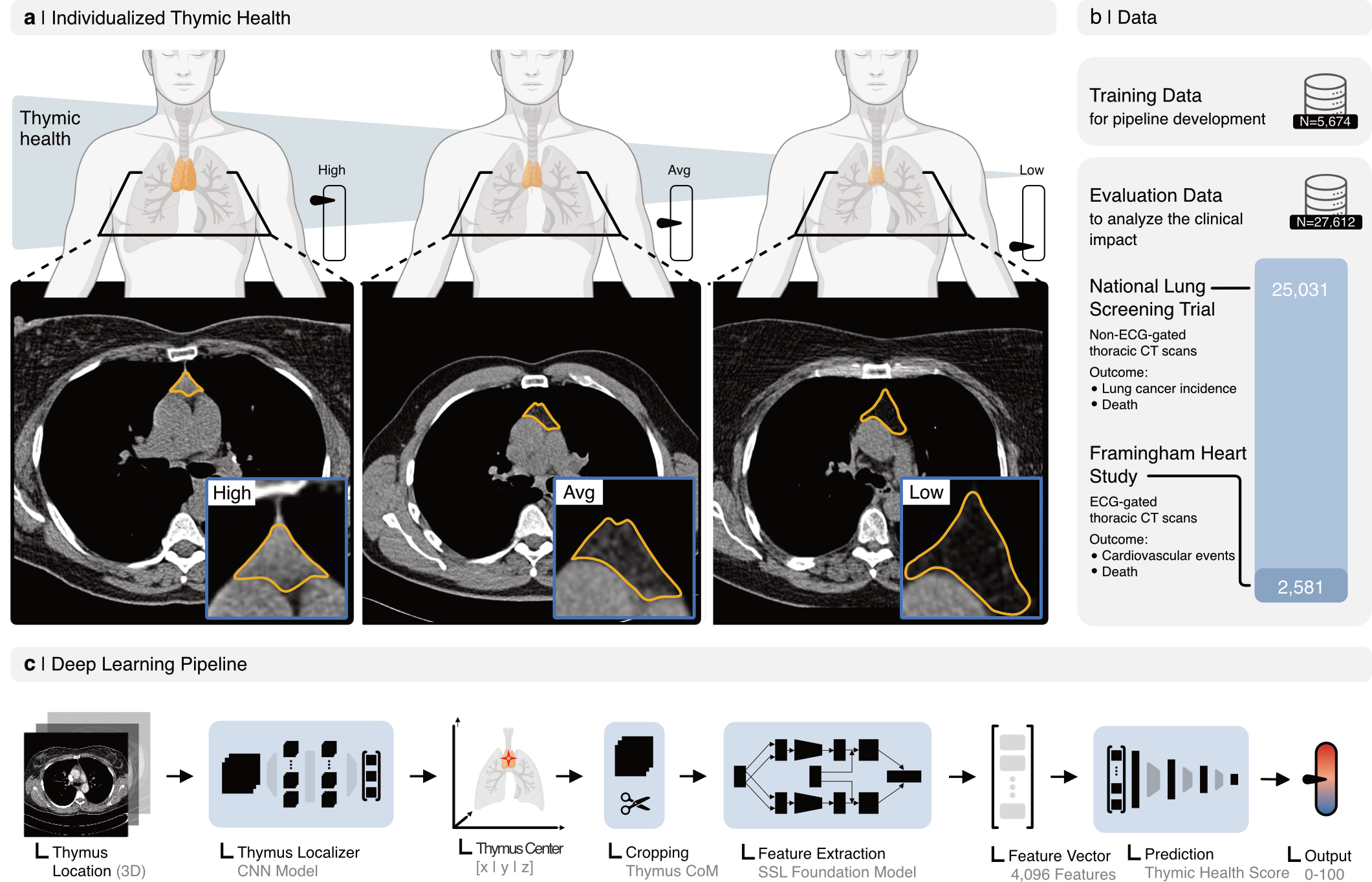
This study examined more than 25,000 adults in a national lung cancer screening trial (NLST) and over 2,500 participants in the Framingham Heart Study (FHS) and observed that people with high thymic health scores had about a 50% lower risk of death, 63% lower risk of cardiovascular death, and 36% lower risk of developing lung cancer compared to those with low thymic health.
Abstract
The thymus is essential for establishing T cell diversity early in life, but undergoes profound involution with age and has therefore traditionally been regarded as largely nonfunctional in adults. Here we propose that preserving thymic functionality is integral to adult health and longevity. We developed a deep learning framework to quantify thymic health from routine radiographic images and evaluated its association with longevity and risk of major age-associated diseases in two large prospective cohorts of asymptomatic adults: the National Lung Screening Trial (n = 25,031) and the Framingham Heart Study (n = 2,581). In both cohorts, thymic health varied markedly across the population. In the National Lung Screening Trial, higher thymic health was consistently associated with lower all-cause mortality, reduced lung cancer incidence and lower cardiovascular mortality over 12 years of follow-up after adjustment for age, sex, smoking and comorbidities. In the independent Framingham Heart Study cohort, higher thymic health was significantly associated with reduced cardiovascular mortality, independent of age, sex and smoking. Thymic health was further linked to systemic inflammation and metabolic dysregulation, and associated with modifiable lifestyle factors including smoking, obesity and physical activity. Together, these findings reposition the thymus as a central regulator of immune-mediated ageing and disease susceptibility in adulthood, highlighting its potential as a target for preventive and regenerative strategies to promote healthy ageing and longevity.
Cite this article
Bernatz, S., Prudente, V., Pai, S. et al. Thymic health consequences in adults. Nature 652, 986–994 (2026). https://doi.org/10.1038/s41586-026-10242-y